
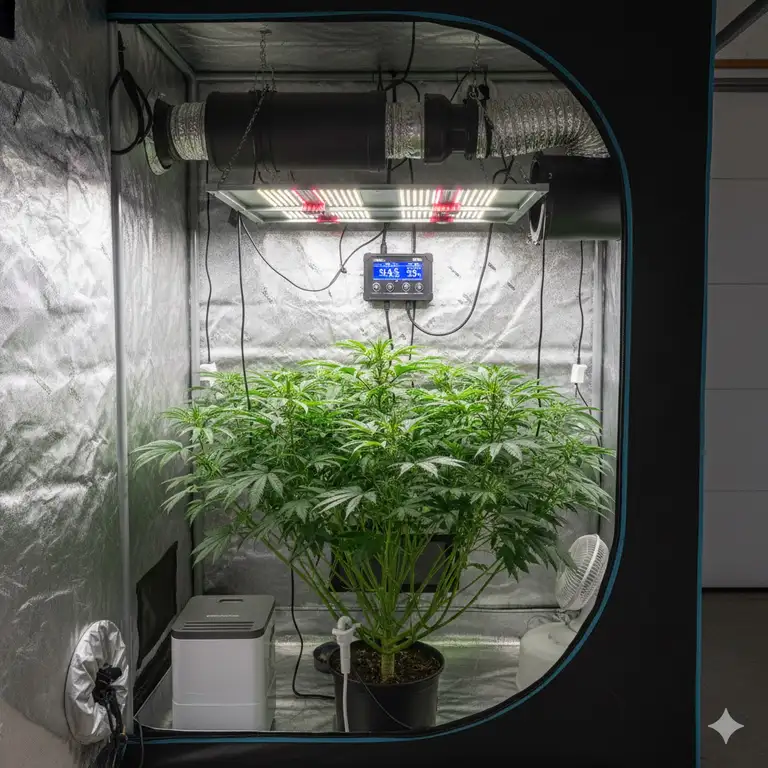
I remember the first time I tried to grow my own peppers indoors. I thought a light and a pot were enough. Within a week, my “garden” looked like a scene from a desert movie—wilting leaves, bone-dry air, and a temperature that could bake a pizza. That was the day I realized that grow tent climate control isn’t just an “extra”; it’s the heartbeat of your entire operation. If you don’t control the weather inside that little black box, the box eventually becomes a coffin for your plants.
✨Was this helpful? Spread the word! 🚀
[addtoany]
Managing a grow tent climate control system in 2026 has become much easier thanks to automation, but the fundamentals remain the same. You need to balance heat, humidity, and airflow to mimic the perfect spring day, every single day. In this guide, I’m going to walk you through the best gear on the market and show you how to set up a grow tent climate control system that basically runs itself.
Quick Comparison: Automated vs. Manual Climate Management
Before we dive into the nitty-gritty, let’s look at how a modern grow tent climate control setup stacks up against the “old school” way of doing things.
| Feature | Automated Grow Tent Climate Control | Manual Monitoring (Old School) |
| Consistency | High – Sensors adjust gear in real-time | Low – Depends on when you check it |
| Labor | Set it and forget it | Requires daily manual adjustments |
| Plant Safety | Built-in alarms for heat/humidity spikes | High risk of overnight crop failure |
| Precision | +/- 1 degree or 1% humidity | Broad ranges and guesswork |
| Energy Efficiency | High – Fans only run when needed | Low – Fans often run 24/7 |
Top 7 Grow Tent Climate Control Systems: Expert Analysis
If you are looking to upgrade your setup, these are the heavy hitters available right now. I’ve personally vetted these based on their reliability, sensor accuracy, and ease of use for growers in the USA.
1. AC Infinity CLOUDLINE T6 (Inline Fan & Controller 69)
The gold standard for mid-sized tents. This isn’t just a fan; it’s the brain of your grow tent climate control system.
-
Technical Specifications: 402 CFM airflow, 32 dBA noise level, PWM-controlled motor, Includes Controller 69 with Bluetooth.
-
Professional Applications: Ideal for 4×4 or 5×5 grow tents requiring precise temperature and humidity triggers.
-
Customer Review Analysis: Users love the “smart” features. One reviewer noted that the fan transitions between speeds so smoothly that it doesn’t disturb the plants or the neighbors. Some found the app setup slightly tricky but praised the customer support.
-
Pros: Ultra-quiet, very energy-efficient, sleek digital interface.
-
Cons: Higher price point than basic fans.
-
Warranty: 2-year limited warranty.
2. VIVOSUN Smart Grow System E42A (Controller & Fan Kit)
VIVOSUN has stepped up its game with the “GrowHub” ecosystem, offering a holistic approach to grow tent climate control.
-
Technical Specifications: 6-inch 440 CFM fan, WiFi-enabled Controller E42A, supports up to 4 devices.
-
Professional Applications: Perfect for growers who want to control lights, fans, and circulation from a single smartphone app.
-
Customer Review Analysis: Most customers highlight the value for money. They appreciate having one app for everything. A few mentioned that the humidity sensor needs occasional recalibration.
-
Pros: Comprehensive ecosystem, very user-friendly app, affordable.
-
Cons: Plastic housing feels less premium than AC Infinity.
-
Warranty: 1-year warranty.
3. Inkbird ITC-308 & IHC-200 Combo (Temperature & Humidity Controllers)
If you already have fans and heaters, this duo is the most cost-effective grow tent climate control upgrade you can buy.
-
Technical Specifications: ITC-308 supports 1200W/10A; IHC-200 supports 10A. Plug-and-play design with dual displays.
-
Professional Applications: Used for retrofitting “dumb” fans, heaters, or humidifiers into an automated climate control for grow tent setup.
-
Customer Review Analysis: Legendarily reliable. Growers have used these for years without a hitch. The main complaint is the short sensor cord length, which might require some creative placement.
-
Pros: Extremely reliable, works with any brand of equipment, affordable.
-
Cons: Not an all-in-one unit; requires a lot of cables.
-
Warranty: 1-year replacement warranty.
4. Niwa Grow Hub+ (Smart Environmental Controller)
The “Rolls Royce” of grow tent climate control for those who want total climate mastery.
-
Technical Specifications: Controls AC, Heaters, Dehumidifiers, Humidifiers, and Fans. Max load 15A. WiFi connectivity.
-
Professional Applications: High-end craft grows where Vapor Pressure Deficit (VPD) management is critical.
-
Customer Review Analysis: Professional growers swear by the Niwa for its ability to calculate VPD on the fly. Some casual hobbyists find the price overkill, but most agree it’s worth it for the crop quality.
-
Pros: Advanced VPD monitoring, handles heavy-duty equipment.
-
Cons: Expensive; requires a stable WiFi connection.
-
Warranty: 1-year standard warranty.
5. Spider Farmer 6-Inch Intelligent Fan (SF-Fan-6)
A rugged, high-performance alternative that focuses on raw power and durability for your grow tent ventilation kit.
-
Technical Specifications: 402 CFM, 10-speed manual/auto controller, IP44 rated for moisture resistance.
-
Professional Applications: Best for humid environments or tents located in garages/sheds.
-
Customer Review Analysis: Users appreciate the build quality. “It feels like it’s built to last ten years,” said one reviewer. Some noted it’s a bit louder than the AC Infinity at max speed.
-
Pros: Durable, easy to clean, powerful airflow.
-
Cons: Controller interface is a bit dated compared to competitors.
-
Warranty: 2-year warranty.
6. Govee WiFi Thermometer Hygrometer H5179 (Sensor Only)
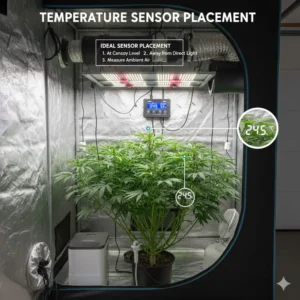
While not a controller, this is an essential part of grow tent temperature and humidity control for monitoring multiple zones.
-
Technical Specifications: Swiss-made sensors, +/- 0.5°F accuracy, WiFi/Bluetooth data logging.
-
Professional Applications: Secondary monitoring to ensure there are no “dead spots” in large grow rooms.
-
Customer Review Analysis: Praised for its tiny size and incredibly accurate app alerts. Some users mentioned that the batteries need replacing every 4-6 months.
-
Pros: Very cheap, highly accurate, excellent data charts.
-
Cons: Doesn’t actually turn equipment on/off.
-
Warranty: 1-year limited.
7. Hon&Guan 6-Inch Mixed Flow Inline Fan (HF-150P)
A lesser-known but high-quality alternative for those on a strict budget who still want an indoor grow climate system.
-
Technical Specifications: 312 CFM, ABS plastic construction, low vibration design.
-
Professional Applications: Budget-conscious 3×3 tents or as an intake fan for larger setups.
-
Customer Review Analysis: Surprise favorite among DIYers. Many were shocked at how quiet it is for the price. The main downside is the lack of a smart controller—it’s strictly “on or off.”
-
Pros: Exceptional value, very quiet, lightweight.
-
Cons: No built-in climate sensors.
-
Warranty: 12-month warranty.
🔍 Don’t Miss These Exclusive Deals!
Take your gardening to the next level with these carefully selected climate tools. Click on any highlighted item to check current pricing and availability on Amazon. ✨
💬 Just one click – help others make better buying decisions too!😊
[addtoany]
Product Specifications Matrix (Spec Matrix)
| Product Name | Airflow (CFM) | Noise (dBA) | Smart Features | App Support | Use Case |
| AC Infinity T6 | 402 | 32 | Temp/Humid Triggers | Bluetooth/WiFi | Mid-size Pro |
| VIVOSUN E42A | 440 | 34 | All-in-one Hub | WiFi | Ecosystem Users |
| Inkbird Combo | N/A | Silent | Dual Relay | No (Standard) | Retrofitting |
| Niwa Hub+ | N/A | Silent | VPD/Full HVAC | WiFi | High-End Craft |
| Spider Farmer | 402 | 35 | 10-Speed Auto | No | Heavy Duty |
| Govee H5179 | N/A | Silent | Data Logging | WiFi | Monitoring Only |
| Hon&Guan | 312 | 30 | Basic Manual | No | Budget Intake |
Budget vs. Premium Comparison
| Category | Budget Choice (Inkbird/Hon&Guan) | Premium Choice (Niwa/AC Infinity) |
| Initial Cost | Low ($40 – $100) | High ($150 – $350+) |
| Setup Time | Quick but cable-heavy | Integrated and clean |
| Long-term Value | Good for learning | Essential for maximizing yield |
| Remote Access | None | Real-time alerts via Smartphone |
The Science of Grow Tent Climate Control
Why do we care so much about grow tent climate controls? Because plants don’t have sweat glands. They use a process called transpiration to stay cool. If your grow tent climate control is off, the plant can’t “breathe” properly.
Temperature: The Foundation
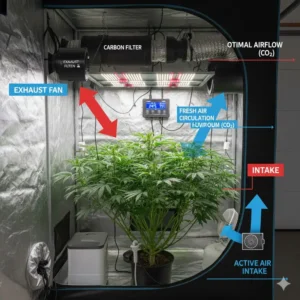
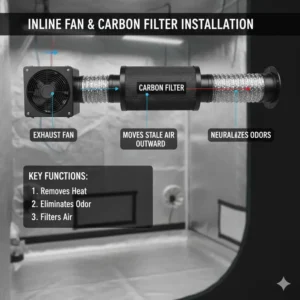
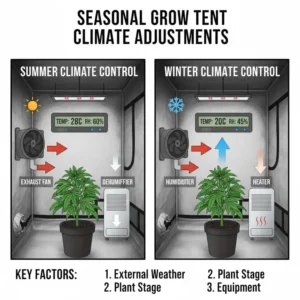
If your tent is too hot (above 85°F), your plants will stretch and become weak. If it’s too cold (below 60°F), their metabolism slows to a crawl. In my experience, keeping the tent between 72°F and 78°F during the “day” cycle is the sweet spot. A high-quality grow tent temperature and humidity control system will use an intake and exhaust fan to swap the hot air from the lights with fresh, cool air from the room.
Humidity: The Moisture Balance
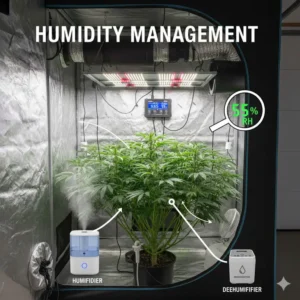
Humidity is the trickiest part of automated grow tent climate control. Young plants love high humidity (60-70%), but flowering plants need it low (40-50%) to prevent mold. Have you ever seen “Bud Rot”? It’s a nightmare. It happens when your humidity spikes overnight. This is why having a humidity-triggered fan is non-negotiable.
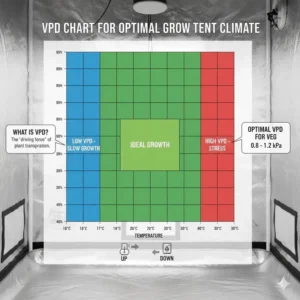
Vapor Pressure Deficit (VPD)
This sounds like a complex physics term, but for an indoor grow climate system, it’s just the relationship between temperature and humidity. It tells you how much “room” the air has to soak up moisture from the plant. In 2026, most advanced grow tent climate control devices, like the Niwa Grow Hub+, calculate this for you automatically.
Benefits Comparison: Automated vs. Traditional Ventilation
| Benefit | Automated System | Traditional Fan (Full Speed) |
| Electricity Savings | Saves ~30% by modulating speed | None |
| Noise Management | Quietest during night cycles | Always loud |
| Equipment Life | Motors last longer | Constant wear and tear |
| Plant Health | No “wind burn” from constant air | High risk of stress |
Setting Up Your Grow Tent Ventilation Kit for Success
Setting up your grow tent ventilation kit isn’t just about hanging a fan. You need to understand air pressure.
-
Exhaust (The “Out”): This should be at the top of your tent. Heat rises! Your main fan should pull air through a carbon filter and push it out of the room. This is the core of your grow tent climate control.
-
Intake (The “In”): You can use a “passive” intake (just a hole in the bottom) or an “active” intake (another fan). An active intake is better for climate control for grow tent setups because it allows you to bring in cool air exactly when the sensors say it’s needed.
-
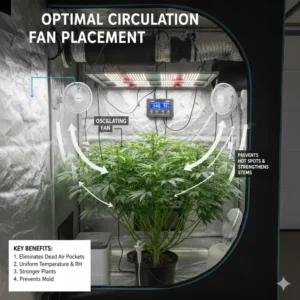
Circulation: Small clip-on fans inside the tent are vital. They prevent “pockets” of hot or humid air from forming around the leaves.
Performance Metrics to Watch
| Metric | Target (Veg) | Target (Flower) | Tool Required |
| Air Exchange | Every 1-3 mins | Every 1 min | Inline Fan |
| Relative Humidity | 60% – 70% | 40% – 50% | Humidifier/Dehumidifier |
| Temperature | 75°F – 80°F | 70°F – 75°F | AC/Heater/Fan |
| VPD | 0.8 – 1.1 kPa | 1.2 – 1.5 kPa | Smart Controller |
How to Choose the Right Climate Control for Grow Tent
Choosing a grow tent climate control system depends on three things: your budget, your tent size, and how much you trust yourself to check on your plants.
-
For Beginners: I always recommend the AC Infinity Cloudline T-Series. It’s the easiest “all-in-one” solution that prevents most common mistakes.
-
For the DIY Expert: Grab an Inkbird controller and pair it with a high-cfm fan like the Spider Farmer. You get the same control for less money, though it looks a bit “mad scientist” with all the wires.
-
For the Tech-Head: The Niwa or VIVOSUN Smart System is the way to go. Being able to check your grow tent climate control from a coffee shop three towns away is a peace of mind you can’t put a price on.
Key Features Comparison Table
| Feature | AC Infinity T6 | VIVOSUN E42A | Inkbird ITC-308 | Niwa Hub+ |
| Integrated Fan | Yes | Yes | No | No |
| Mobile App | Yes | Yes | No (Standard) | Yes |
| VPD Tracking | Yes | Yes | No | Yes |
| Price Point | Mid-Range | Mid-Range | Budget | Premium |
| Expansion | Limited | High | Unlimited | High |
Troubleshooting Your Indoor Grow Climate System
Even with the best grow tent climate control, things can go wrong. Here’s a quick guide to fixing common issues:
-
Problem: Humidity is too high even with the fan at 100%.
-
Solution: Your “lung room” (the room the tent is in) is too humid. You need a dehumidifier in the room, not just the tent.
-
-
Problem: The tent is sucking inward (Too much negative pressure).
-
Solution: Open your intake vents or turn down the exhaust fan. A little “inward bow” is good for smell control, but don’t let it crush your plants!
-
-
Problem: Temperature won’t drop at night.
-
Solution: Check if your lights are still on or if your lung room is too warm. You might need to run your “day” cycle at night when it’s cooler outside.
-
✨ Ready to build your dream garden?
Check out the latest grow tent climate control gear and start your journey toward expert-level yields today! 🔍
Conclusion: Mastering the Environment
At the end of the day, a grow tent climate control system is an investment in your harvest. You can buy the most expensive seeds and the best lights, but if your air is stale and your tent is a sauna, you’re just wasting money.
I’ve learned the hard way that automation is your best friend. Start with a solid foundation—a great inline fan and a reliable controller. Once you see your plants thriving in a perfectly tuned indoor grow climate system, you’ll never go back to manual monitoring again.
Whether you choose the high-tech integration of the AC Infinity T6 or the rugged simplicity of an Inkbird setup, the goal is the same: consistency. Happy growing!
FAQs
❓ What is the best temperature for a grow tent climate control system?
❓ Do I really need a smart controller for grow tent climate control?
❓ How much airflow does my grow tent ventilation kit need?
❓ Can grow tent climate control help with smell?
❓ How do I lower humidity in my grow tent without a dehumidifier?
Recommended for You
- Best DWC System of 2025: 7+ Expert Reviews for Explosive Growth
- Best Tomatoes to Grow Indoors: Your Ultimate Guide to a Year-Round Harvest 🍅 [2026]
- Hydroponic Greenhouse: 7 Powerful Benefits for Faster, Healthier Plant Growth
Disclaimer: This article contains affiliate links. If you purchase products through these links, we may earn a small commission at no additional cost to you.
✨ Found this helpful? Share it with your friends! 💬🤗
[addtoany]
