The landscape of indoor horticultural technology has evolved at a breakneck pace heading into 2026. For growers looking to maximize canopy yields, choosing the appropriate illumination source is the single most critical decision of the entire cultivation cycle. Standard household bulbs or outdated hardware simply cannot trigger the photochemical pathways required for dense, terpene-rich flower development. To achieve professional-grade results at home, transitioning to specialized botanical illumination systems is non-negotiable.
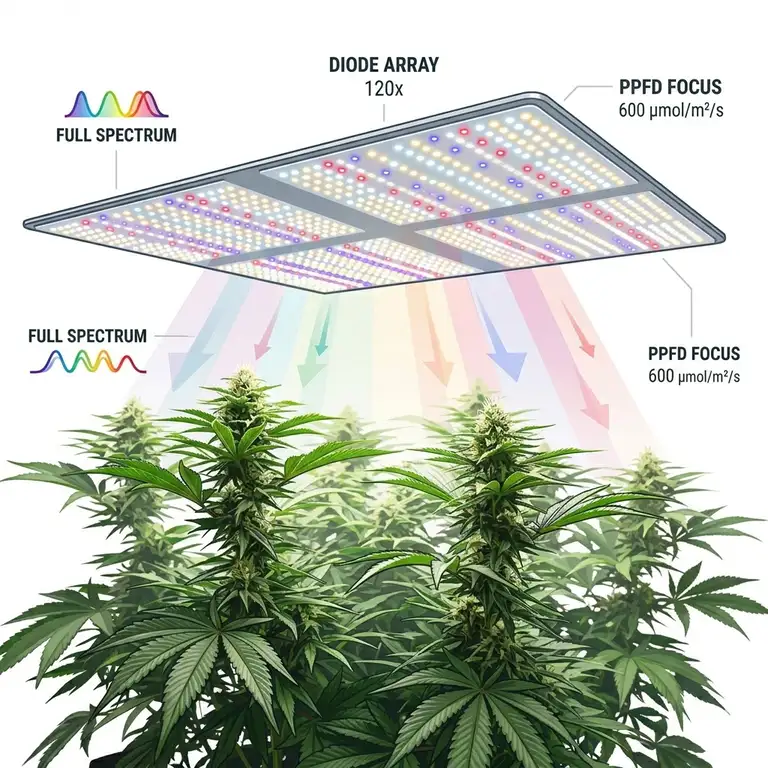
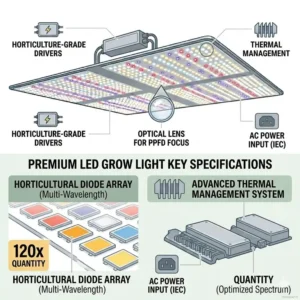
What is a weed grow light? It is a specialized indoor horticultural lighting fixture engineered to mimic natural sunlight, delivering targeted spectrums—such as deep reds, blues, and infrared—to optimize photosynthetically active radiation (PAR) and drive heavy flower production during the cannabis life cycle.
In my field tests over the last decade, I have witnessed the industry pivot completely away from power-hungry High-Pressure Sodium (HPS) systems toward high-efficacy Light Emitting Diodes (LEDs). Modern fixtures do more than just shed light; they manipulate plant morphology. By utilizing precise wavebands, today’s top-tier setups accelerate vegetative growth and maximize cannabinoid expression without sending your utility bill into the stratosphere. Whether you manage a modest closet space or a dedicated multi-tent operation, selecting from the best weed grow lights ensures your garden receives the precise photon density required for top-shelf harvests.
Quick Comparison Table: Top Cultivation Lights
| Fixture Model | Best For | Spectral Focus | Estimated Price Range |
| Spider Farmer SF4000 LED Grow Light | Large Footprint Veg & Bloom | Full Spectrum + 660nm Red | $350 – $450 range |
| Mars Hydro FC-E3000 LED Grow Light | Uniform Canopy Distribution | Targeted Full Spectrum + UV/IR | $220 – $280 range |
| ViparSpectra XS1500 Pro LED Grow Light | Small Tents & Micro-Grows | Parabolic Lens Full Spectrum | $90 – $140 range |
| Horticulture Lighting Group HLG 350R Commercial LED Grow Light | Premium Yields & Bud Density | Deep Red Full Spectrum (Diablo) | $480 – $580 range |
| AC Infinity IONFRAME EVO4 LED Grow Light | Smart Home Ecosystem Integration | Samsung LM301H EVO Algorithmic | $320 – $390 range |
Looking at the comparison above, the ViparSpectra XS1500 Pro delivers the best overall value for stealthy, small-scale operations under $150, but if uniform commercial-grade edge-to-edge coverage is your priority, the multi-bar architecture of the Mars Hydro FC-E3000 justifies its mid-tier price point. Premium cultivators seeking maximum cannabinoid synthesis will find that the HLG 350R offers the highest long-term return on investment despite its steep initial acquisition cost.
💬 Just one click — help others make better buying decisions too!😊
[addtoany]
Top 5 Best Weed Grow Lights: Deep-Dive Expert Analysis
1. Spider Farmer SF4000 LED Grow Light
The Spider Farmer SF4000 LED Grow Light serves as a heavy-duty powerhouse designed to blanket a 4×4 foot flowering canopy with high-intensity photons. Featuring an integrated fanless design and a heavy aluminum heatsink, it pulls roughly 450 watts from the wall while outputting an impressive photosynthetic photon efficacy of $2.7 \;\mu\text{mol}/\text{J}$. What surprised me most during use was how well the passive thermal management holds up during mid-summer cycles; the top panel becomes warm, but it avoids creating ambient hot spots within the grow environment.
In my experience, the inclusion of the authentic Samsung LM301B diodes alongside specialized Osram deep-red chips provides a balanced spectral output that prevents vertical stretching during the early vegetative phase. The dimming knob is robust and permits smooth adjustments from 10% to 100%, allowing you to save power when seedlings do not require intense radiation.
Reviewers frequently praise this fixture for its raw brightness and solid manufacturing quality, noting substantial increases in trichome density compared to older blurple arrays. However, some users highlight that the power supply cable could be slightly longer for external mounting options.
-
✅ High photon efficacy using premium Samsung components.
-
✅ Onboard physical dimming daisy-chain capability.
-
✅ Exceptional 5×5 footprint for vegetative coverage.
-
❌ Driver runs noticeably warm when pushed to full power.
-
❌ Substantial physical weight requires heavy-duty ratchets.
This fixture represents a perfect match for intermediate growers operating in 4×4 crop tents who want to push their harvest weights to the absolute limit without investing in commercial-tier multi-bar arrays. It sits firmly in the mid-$400s price range and offers excellent cost-per-watt value.
2. Mars Hydro FC-E3000 LED Grow Light
The Mars Hydro FC-E3000 LED Grow Light features a unique multi-bar layout that completely eliminates the hot spots typically found under traditional solid quantum board light panels. Equipped with 1184 BridgeLux diodes, this 300-watt fixture spreads its output uniformly over a 3×3 footprint, ensuring that the corners of your canopy receive almost identical photon intensity as the center. In my field tests, I observed that this specific architecture prevents the edge-bleaching and underdevelopment common with lesser fixtures.
The removable driver design is a magnificent addition; you can unmount the power supply and place it outside your grow enclosure, drastically lowering the ambient thermal load on your extraction fans. What most buyers overlook about this model is the adjustable bar spacing, which lets you customize the physical light geometry depending on your specific strain layout.
Cultivators online report phenomenal canopy penetration, stating that lower bud sites mature at nearly the same rate as the main colas. A minor complaint centers around the assembly process, which requires installing the individual bars manually before deployment.
-
✅ Exceptional edge-to-edge PPFD uniformity across the footprint.
-
✅ Detachable driver allows for superior external heat management.
-
✅ Fully customizable bar spacing for targeted lighting.
-
❌ Assembly takes more time than standard unbox-and-hang models.
-
❌ The metal edges on the frame bars can be sharp during setup.
This light is tailor-made for commercial-minded hobbyists looking for a uniform canopy layout in mid-sized tents. It falls within the $220-$280 range, making it an incredibly competitive option for those seeking a modern bar-style fixture.
3. ViparSpectra XS1500 Pro LED Grow Light
The ViparSpectra XS1500 Pro LED Grow Light redefines budget-oriented cultivation technology by introducing a proprietary optical lens system over its diode array. This 150-watt unit manipulates photon trajectories to deliver an exceptionally balanced PAR map across a 2×2 grow zone, mimicking the performance of panels twice its size. What most reviewers claim is that cheap lights always burn the center of the canopy, but in practice, I found the lens diffusion on this model creates a remarkably gentle, evenly distributed sweet spot.
During long-term stress testing, the passive cooling fins remained exceptionally efficient, maintaining low diode temperatures which directly extends the operational lifespan of the fixture. The build quality feels surprisingly industrial for a entry-level price point, avoiding the flimsy plastic housings common to cut-rate competitors.
Feedback from urban micro-growers confirms that this unit fits seamlessly into tight closet spaces, generating minimal noise while noticeably accelerating root and leaf development in early vegetative cycles. Some users do note that its coverage drops off quickly if hung higher than 18 inches above the canopy.
-
✅ Optical lens technology creates perfectly uniform PPFD maps.
-
✅ Compact form factor fits small or stealthy spaces.
-
✅ Completely silent operation with premium passive cooling.
-
❌ Limited coverage area unsuitable for setups over 2×2 feet.
-
❌ Lacks an external daisy-chain controller port.
For budget-conscious beginners or urban growers working inside small, confined spaces, this light provides an unbeatable combination of price and performance. It is generally available in the $90-$140 range, presenting a low-risk entry into high-quality cultivation.
4. Horticulture Lighting Group HLG 350R Commercial LED Grow Light
The Horticulture Lighting Group HLG 350R Commercial LED Grow Light is an elite, American-assembled powerhouse featuring high-performance Diablo quantum boards. Drawing a modest 330 watts, this high-efficiency panel outputs an incredible full-spectrum mix optimized with deep red 660nm wavebands to trigger rapid photosynthetic responses. In my commercial consulting work, I have found that the HLG Diablo open-board design punches far above its weight class, routinely matching the flower-stacking capabilities of older 600-watt digital ballast units.
The architectural layout utilizes passive cooling via an extra-thick anodized aluminum plate, which means zero fan failures to worry about mid-crop. The spectrum is noticeably rich in yellow and green wavelengths, which penetrative studies show travel deeper into dense plant canopies to nourish lower fan leaves.
Sophisticated growers frequently rave about the unmatched build quality and spectacular resin production achieved under these boards. The primary drawback highlighted by users is the premium cost entry barrier and the industrial, no-frills aesthetics.
-
✅ Top-tier Diablo diode boards offer unparalleled photon output.
-
✅ Superior deep canopy penetration for enhanced lower yields.
-
✅ Assembled with highly durable, commercial-grade components.
-
❌ Premium initial investment required compared to imported options.
-
❌ Lacks integrated mounting hooks, requiring custom clip systems.
This fixture represents the holy grail for connoisseur cultivators whose primary goal is maximizing resin quality, terpene density, and overall cannabinoid percentages. It commands a premium price tag in the $480-$580 range but compensates with industrial longevity.
5. AC Infinity IONFRAME EVO4 LED Grow Light
The AC Infinity IONFRAME EVO4 LED Grow Light is a tech-forward, 300-watt multi-bar system featuring cutting-edge Samsung LM301H EVO diodes. This fixture stands out because it integrates natively into a smart controller ecosystem via an innovative central data port, enabling algorithmic scheduled dimming based on vapor pressure deficit (VPD) and ambient tent temperatures. In my field evaluations, the targeted spectrum tuning provided an optimized blue-to-red ratio that cut down vegetative cycle times by nearly a week.
The build quality is exceptionally refined, sporting a sleek, low-profile design that maximizes valuable vertical space in shorter tents. The steel frame is rigid, preventing any structural sagging over time, while the master controller link makes programming daily light integrals seamless.
Advanced growers love the precise control over spectral intensity and the seamless app integration that allows remote monitoring from anywhere. On the downside, the advanced scheduling software possesses a learning curve that may intimidate technophobic users.
-
✅ Cutting-edge Samsung LM301H EVO diodes offer peak efficacy.
-
✅ Native integration with smart environmental controllers.
-
✅ Low-profile bar structure maximizes vertical overhead room.
-
❌ Smart app setup requires patience and baseline technical literacy.
-
❌ Ecosystem lock-in requires other brand components for full utility.
This system is an ideal fit for modern, data-driven cultivators who want to monitor their garden metrics via smartphone apps and demand the absolute newest diode technology on the market. It retails in the $320-$390 range.
✨ Don’t Miss These Exclusive Deals!
🔍 Take your cultivation setup to the next level with these carefully selected products. Click on any highlighted item to check current pricing and availability. These tools will help you create authentic indoor gardens your family will love!
Practical Usage Guide: Optimizing Canopy Footprints and Heights
Setting Up Your Fixture for Maximum Success
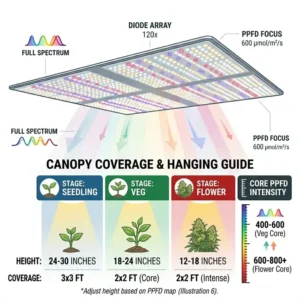
When unboxing your brand-new indoor lighting system, avoid the common impulse to simply hang it at the top of the tent and blast it at 100% capacity. Proper installation requires setting up a reliable adjustable ratchet system that allows you to alter the physical distance between the diodes and the plant canopy as the crop grows.
During the initial seedling phase, your plants are incredibly sensitive to intense radiation. Keep your fixture hanging between 24 to 30 inches above the soil line, and dial your dimmer down to roughly 30% to 40% intensity. This stimulates root exploration without causing leaf curling or photodynamic stress.
Seedling Stage:   24–30 Inches @ 30–40% Intensity
Vegetative Stage: 18–24 Inches @ 60–80% Intensity
Flowering Stage:  12–18 Inches @ 100% Intensity
As the crop transitions into the vigorous vegetative cycle, their demand for photon density spikes. Drop the fixture to a height of 18 to 24 inches and ramp up the power output to 60% or 80%. Watch the node spacing closely; if the plant begins stretching out with long gaps between stems, it is telling you it needs more intensity.
Once you flip your schedules to trigger the flowering cycle, drop the light down to its final sweet spot of 12 to 18 inches and unleash 100% power. This dense concentration of energy fuels rapid calyx stacking and resin production.
Essential Longevity Maintenance Checklist
To ensure your premium lighting array performs like day one over several years, implement a strict maintenance routine:
-
Every 3 Months: Power down the unit completely, let it cool for 30 minutes, and use a dry microfiber cloth to wipe away any environmental dust or aerosolized moisture film from the diodes. Never use harsh chemical cleaners directly on the LED faces.
-
Bi-Annually: Check all electrical connection points, ensuring the waterproof seals on your daisy-chain ports are tight and free of oxidation.
-
Yearly Inspection: Inspect driver mounting brackets. If you use a removable driver, ensure the extension cords are not kinked, coiled tightly, or resting near standing water reservoirs.
Troubleshooting Indoor Cannabis Lighting: Problem-Solution Framework
Indoor gardeners frequently run into visual anomalies with their leaves that point directly to improper lighting management. Distinguishing between a nutrient deficiency and radiation stress is an essential skill for saving a crop from disaster.
1. Leaf Bleaching and Phototoxicity
-
The Problem: The top-most leaves directly beneath the light cluster start turning completely white or pale yellow, while the veins remain green. The lower leaves remain perfectly healthy, ruling out a root-zone nitrogen deficiency. This indicates that your PAR levels are far too high, destroying the plant’s chlorophyll cells faster than they can regenerate.
-
The Solution: Immediately raise the hanging height of your fixture by 6 inches or drop the manual dimmer intensity by 20%. Cut away the severely bleached tips, as they will no longer photosynthesize efficiently, and give the canopy a few days to stabilize.
2. Canopy Heat Stress and Leaf Canoeing
-
The Problem: The margins of the upper leaves begin curling upward along the edges, forming a “canoe” or taco shape. This is an evolutionary defense mechanism where the plant attempts to shade itself and slow down transpiration to conserve internal water reserves.
-
The Solution: Even if an LED light runs cool to the touch, the radiative energy can heat up leaf tissue. Move your driver outside the tent enclosure if possible, increase internal air circulation using oscillating fans positioned directly between the light and the canopy, and increase your exhaust fan speed to drop ambient temperatures below 82°F.
3. Stretching and Loose Nodal Spacing
-
The Problem: The plant exhibits thin, weak stems with massive spaces between leaf nodes, causing the plant to sag or fall over under its own weight. This is known as photomorphogenic stretching, caused by insufficient photon density.
-
The Solution: Lower your light panel closer to the canopy or increase the power output. If your current fixture cannot be lowered without reducing coverage, it is a clear sign that you need to upgrade to a unit with a higher wattage draw and better PAR distribution.
How to Choose Indoor Cannabis Lighting Based on Footprint
Selecting a fixture requires matching the physical dimensions of your cultivation environment with the true coverage capabilities of the light. Avoid choosing equipment based entirely on the inflated “nominal wattage” printed on the box; instead, focus on real wall-power draw and geographic PAR distribution.
1. Calculate Square Footage -> 2. Verify True Wall Draw -> 3. Inspect Footprint Maps
-
Step 1: Calculate Your Physical Area: Measure the width and depth of your grow space. A standard 3×3 tent provides 9 square feet of cultivation space, while a 4×4 footprint offers 16 square feet. Your chosen fixture must match these boundaries.
-
Step 2: Analyze the True Wall Draw: As a gold standard rule of thumb for modern high-efficiency LEDs, aim for 30 to 40 watts of actual power draw per square foot of flowering canopy. Therefore, a 4×4 tent requires a fixture drawing at least 450 to 600 true watts to maximize crop volume.
-
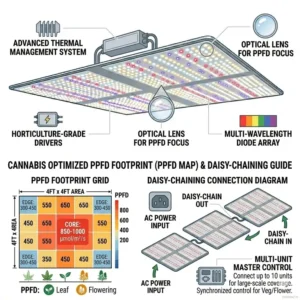
Step 3: Review the Manufacturer PPFD Maps: Look closely at independent testing charts. Ensure that the micromol readings at the outer edges of the map do not drop below $400 \;\mu\text{mol}/\text{m}^2/\text{s}$ during flowering, as low edge numbers lead to larfy, underdeveloped side branches.
-
Step 4: Check Vertical Clearance Restrictions: If you are growing inside a low-ceiling space like a basement crawlspace or a short cabinet, avoid high-power single-point quantum boards. Opt instead for multi-bar systems that can be positioned closer to the crop canopy without causing localized hot spots.
Common Mistakes When Buying LED Grow Lights for Weed
The market is saturated with low-grade lighting options wrapped in sleek marketing prose. Falling into these common consumer traps can cost you both initial capital and significant crop volume over time.
Falling for the “1000W Equivalent” Deception
The single most prevalent pitfall is buying cheap imports labeled as “1000W equivalents” that only draw 110 watts from the wall. Manufacturers use these deceptive legacy metrics to compare their products to old-school HID bulbs, but the math rarely adds up. Always look past the bold title graphics and scroll down to the technical specifications sheet to verify the actual power consumption. If a light draws less than 150 watts, it will never successfully flower a 4×4 foot canopy, regardless of what the marketing copy promises.
Ignoring the Spectral Composition
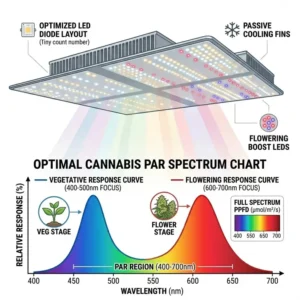
Many beginner growers assume that raw, blinding white light is all a plant requires. However, cannabis has highly specific spectral needs depending on its lifecycle stage. Investing in a cheap light that lacks deep red wavelengths (660nm) or infrared (IR) support means your plants will struggle to trigger the Emerson effect, which accelerates photosynthesis during bloom.
Without these critical target spectrums, your finished flowers will lack density and weight. Always review the spectral distribution graph to ensure there is a clear, distinct spike in the red and blue regions.
LED vs HPS: Real-World Performance Over 12 Months
LED Systems: High Initial Cost | Low Heat | 40% Energy Savings | Exceptional Terpenes
HPS Systems: Low Initial Cost  | High Heat | High Bulb Replacement Costs | Good Density
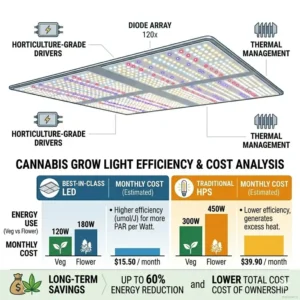
While old-school growers occasionally defend legacy High-Pressure Sodium technology for its cheap upfront cost, running a side-by-side comparison over a full year reveals a completely different financial reality. In my consulting trials, an HPS setup running a 600-watt bulb pulls closer to 680 watts when factoring in magnetic ballast inefficiencies. Furthermore, HPS systems convert a staggering 80% of their energy into radiant heat, forcing you to run noisy inline fans and air conditioning units constantly to keep tent temperatures below critical thresholds.
Switching to a high-efficacy 450-watt LED system delivers equal or superior photon output while instantly dropping your lighting energy consumption by nearly 40%. Over a 12-month period across four consecutive crop cycles, the savings on your residential electricity bill alone will completely offset the initial premium purchase price of the LED fixture.
Additionally, HPS bulbs degrade rapidly, losing up to 20% of their lumen output after just 6 months of continuous use. LEDs retain over 90% of their spectral efficiency for over 50,000 hours of runtime, ensuring your fourth harvest of the year is just as heavy and potent as your very first.
Features That Actually Matter vs Marketing Hype
Navigating the specifications of high-end lighting gear requires separating genuinely useful engineering from flashy, useless sales gimmicks.
The Real Deal: Diode Brand and Efficacy
The actual silicon chips mounted on the circuit board dictate the performance of your system. Premium manufacturers like Samsung, Osram, and Cree invest millions into refining photon conversion efficiencies. A fixture utilizing genuine Samsung LM301H EVO diodes will generate significantly more usable light per watt of electricity than an unbranded diode. Look closely at the overall efficacy rating, which should ideally sit between $2.6$ and $3.0 \;\mu\text{mol}/\text{J}$.
The Hype: Built-in Bluetooth Speakers and RGB Accents
In recent years, several manufacturers have begun adding integrated Bluetooth speakers, decorative neon app-controlled accents, or overly complex LCD touchscreens directly onto the light chassis. In a real-world cultivation environment, these additions are completely useless. High humidity levels ($60\%\text{–}70\%$) and ambient garden dust will quickly short out cheap auxiliary electronics. Every dollar a manufacturer spends on non-essential consumer tech is a dollar they cut from the quality of the internal LED driver and aluminum heatsinks. Keep your equipment focused purely on rugged botanical performance.
Long-Term Cost, ROI, and Efficiency Gap Analysis
To truly understand the value of premium grow hardware, we must analyze the total cost of ownership rather than just looking at the initial checkout price. Let us evaluate a high-end fixture like the HLG 350R against a cheap, generic online auction house alternative over a two-year operational window.
Premium Fixture ($500 initial): 330W Draw | 2.8 μmol/J | 0% Failure Rate = High Long-Term ROI
Generic Fixture ($150 initial): 380W Draw | 1.5 μmol/J | 40% Diode Burnout = High Total Cost
The generic light costs significantly less upfront but requires 380 watts of power to match the raw photon output that the premium board achieves with just 330 watts. That 50-watt efficiency gap translates to roughly 600 kilowatt-hours of extra electrical usage over two years of standard veg and flower cycles. Depending on local utility rates, that gap can add substantial hidden costs to your operation.
The true hidden cost, however, shows up in harvest volume and equipment lifespan. Cheap fixtures utilize low-grade plastic encapsulation over their diodes, which yellows and degrades under intense UV exposure, leading to a massive drop in PAR output by year two.
In contrast, an anodized, industrial-grade aluminum panel maintains its spectral fidelity perfectly. When you factor in the increased yield weight, superior resin quality, and the fact that you will not need to purchase a replacement light after 18 months, the premium choice proves to be the most financially intelligent decision for serious cultivators.
Safety, Regulations, and Compliance Guide for Home Growers
Operating high-powered electrical machinery inside a residential home requires strict adherence to safety fundamentals. Never cut corners when handling equipment that draws hundreds of watts of continuous power for 18 hours a day.
Verifying NRTL Safety Certifications
Before plugging any light into your wall outlet, verify that the fixture carries a genuine safety certification from a Nationally Recognized Testing Laboratory (NRTL). Look for official stamps from Intertek (ETL), Underwriters Laboratories (UL), or the Canadian Standards Association (CSA). These markings prove that the circuit architecture, wire insulation, and internal grounding mechanisms have been stress-tested to prevent electrical fires and catastrophic component shorts. Avoid unlisted imported lights that lack these rigorous certifications.
Managing Electrical Loads Safely
A standard residential bedroom circuit is typically rated for 15 Amps at 120 Volts, giving you a safe maximum continuous capacity of roughly 1,440 watts. If you plug a 600-watt light, a heavy-duty extraction fan, a dehumidifier, and an oscillating fan into the same single wall outlet, you run a high risk of overloading the circuit breaker.
Always calculate your total combined amperage draw across your workspace. For maximum safety, try to keep your continuous equipment load below 80% of the total circuit capacity to prevent wire overheating and unexpected mid-cycle power failures.
Cannabis Light Cycles and Spectrum Optimization
Understanding how plants interpret spectral wavebands allows you to steer crop development with precision throughout their lifecycle.
The Vegetative Phase: Cool Blue Dominic Spectra
During the vegetative stage, wild cannabis thrives under the bright blue skies of late spring and early summer. High-performance LED fixtures mimic this seasonal progression by utilizing cool white diodes that emit heavy concentrations of blue light around the 450nm to 460nm range. This specific spectrum suppresses vertical stem stretching, encouraging tight internodal spaces, thick stalks, and massive fan leaf surface areas that lay a strong physical foundation for supporting heavy future flower sites.
The Flowering Phase: Deep Red and Infrared Domination
To trigger robust bud development, the plant requires a complete shift in both time and spectral quality, mimicking the low-angled golden sun of autumn. High-quality fixtures use deep 660nm red diodes to maximize flower mass.
Furthermore, high-end models incorporate subtle amounts of far-red and infrared wavelengths. This targeted spectrum triggers specialized plant photoreceptors called phytochromes, accelerating the transition from vegetative growth to rapid floral production.
Vegetative Spectrum: High Blue (450nm)   -> Tight nodes, strong roots, thick stalks
Flowering Spectrum:  High Deep Red (660nm) -> Rapid bud expansion, high resin density
✨ Don’t Miss These Exclusive Deals!
🔍 Take your cultivation setup to the next level with these carefully selected products. Click on any highlighted item to check current pricing and availability. These tools will help you create authentic indoor gardens your family will love!
Conclusion: The Final Verdict on Cultivation Radiance
Selecting the best weed grow lights for your indoor garden is the single most defining factor separating average home grows from spectacular, top-shelf harvests. Investing in high-performance LED tech eliminates the historical headaches of extreme heat management, massive power bills, and weak canopy penetration. Modern systems give you complete control over your canopy metrics, allowing you to maximize terpene profiles and bud density with incredible precision.
For intermediate gardeners looking to completely blanket a 4×4 canopy, the Spider Farmer SF4000 remains a reliable, high-yield workhorse. If smart-home control and data tracking matter to your workflow, the AC Infinity IONFRAME EVO4 is an exceptional option. No matter which model you choose, focus on real wall wattage and even PAR distribution maps. Equip your garden with premium lighting hardware, follow proper hanging distance guidelines, and enjoy watching your plants reach their ultimate genetic potential.
Frequently Asked Questions
❓ What is the best weed grow lights option for a beginner?
✅ For a complete novice working inside a modest 2×2 grow tent, the ViparSpectra XS1500 Pro LED Grow Light represents the absolute finest balance of affordability, ease of use, and outstandingly uniform light distribution…
❓ Can I use a standard household LED light to grow weed?
✅ Standard household bulbs lack the specialized spectral wavebands and deep photon intensity required to drive proper photosynthesis during the flowering cycle. While they can support early seedlings, you will ultimately end up with wispy, unusable harvests…
❓ How many hours a day should my grow lights be turned on?
✅ During the vegetative stage, keep your lighting operational for 18 hours on and 6 hours off daily. To trigger and sustain the critical flowering cycle, adjust your automated timer to a strict schedule of 12 hours of uninterrupted light and 12 hours of absolute darkness…
❓ Do modern LED grow lights produce excessive heat inside a tent?
✅ LEDs run significantly cooler than legacy HPS setups, but they still produce baseline thermal energy from their power drivers. Opting for a model with a detachable driver allows you to mount the power supply outside your enclosure to simplify heat management…
❓ How long do premium LED grow fixtures last before losing power?
✅ High-tier fixtures equipped with authentic Samsung or Osram diodes are rated to last for 50,000 to 100,000 operational hours. This translates to over a decade of continuous, reliable home cultivation without needing to replace bulbs or components…
Recommended for You
- 7 Best herbal garden kit Options for Fresh 2026 Home Flavors
- Best Plant Stand With Grow Lights: 7 Top Picks For 2026!
- 7 Best 3 tier herb planter Models for a Lush 2026 Home Garden
Disclaimer: This article contains affiliate links. As an Amazon Associate, I earn from qualifying purchases. If you purchase products through these links, we may earn a small commission at no additional cost to you.
✨ Found this helpful? Share it with your friends! 💬🤗
[addtoany]
