If you had told me a decade ago that I would be obsessing over the structural integrity of tiny plastic baskets, I would have laughed. But after 10 years of designing and troubleshooting deep water culture (DWC) and nutrient film technique (NFT) systems for commercial indoor farms and basement hobbyists alike, I’ve learned a hard truth: your entire harvest literally hinges on your choice of netting cups.
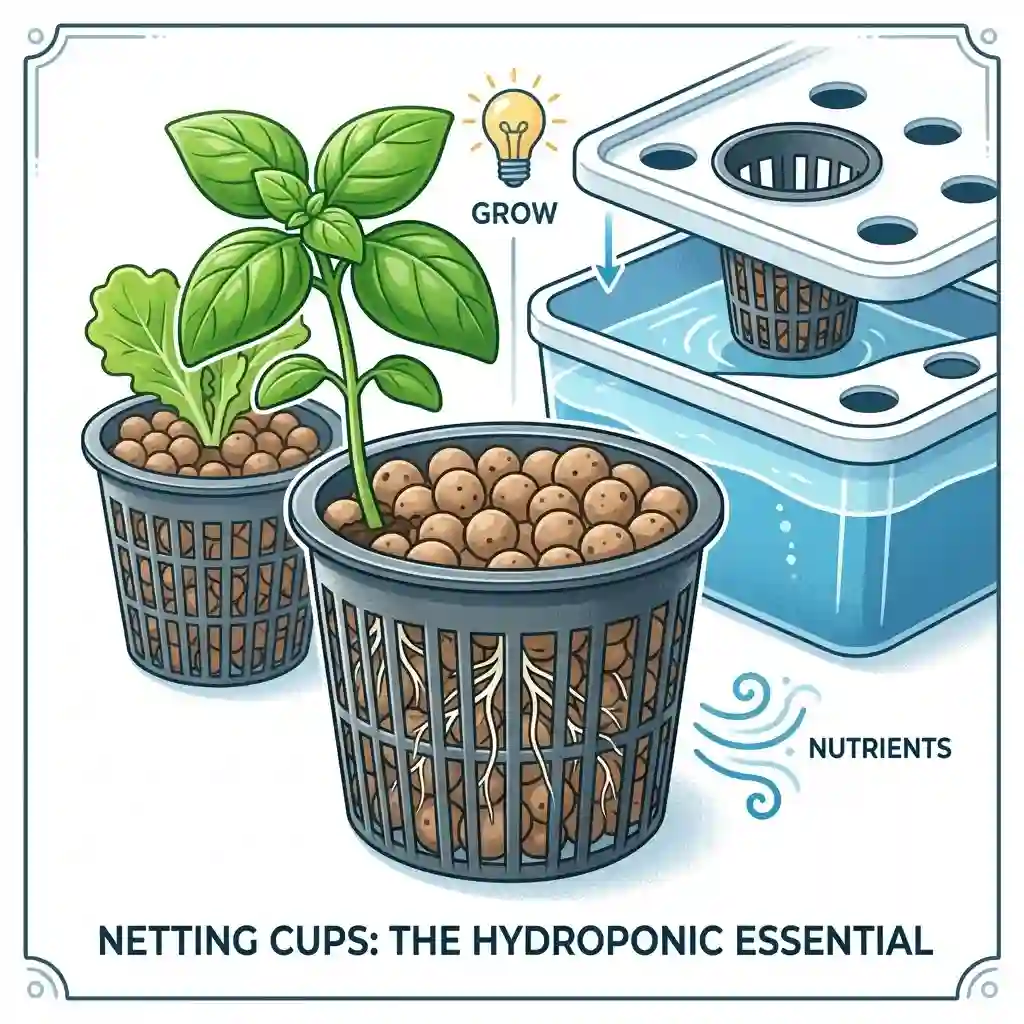
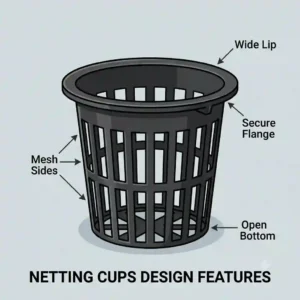
So, what are netting cups? In agricultural terms, they are slotted mesh containers designed to hold inert growing media (like clay pebbles or rockwool) while allowing roots to grow freely through the gaps into a nutrient-rich water solution. They act as the primary interface between the vegetative canopy above and the aquatic root zone below.
Most beginners spend thousands on premium LED grow lights and perfectly balanced nutrients, only to experience catastrophic crop failure because they bought the cheapest plastic baskets they could find. In my field tests, I’ve seen thin plastic collapse under the weight of a mature tomato plant, plunging the entire crown into the reservoir. I’ve dealt with light leaks through oversized mesh slits that triggered massive algae blooms, suffocating the roots.
The industry has evolved significantly by 2026. We are no longer limited to fragile, single-use plastics. Today’s market offers UV-resistant, BPA-free, wide-lipped engineering marvels that can survive years of aggressive root growth and heavy cleaning. In this comprehensive guide, we aren’t just looking at spec sheets. We are diving deep into the real-world performance, structural tolerances, and specific use-case scenarios for the top options available today. Let’s find the perfect foundation for your next grow.
Quick Comparison Table: Top Contenders Analyzed
| Product | Size | Best For | Key Standout Feature | Estimated Price Range |
| CZ Garden Heavy Duty | 2-inch | DWC & NFT Systems | Extremely wide lip | Under $15 (50-pack) |
| Growneer with Labels | 3-inch | Beginner Hobbyists | Includes wicking ropes | $15 – $20 range |
| Viagrow VNC3-50 | 3-inch | Budget Single-Season | High airflow slit ratio | Under $10 (50-pack) |
| Hydrofarm Grotube | 2-inch | Commercial NFT | Low-profile rim | $20 – $25 range |
| VIVOSUN Heavy Duty | 6-inch | Large Fruiting Plants | Massive load capacity | $25 – $35 range |
Looking at the comparison above, the CZ Garden Heavy Duty delivers the best overall long-term value for standard 2-inch systems, as its wide lip prevents the dreaded “reservoir drop” that plagues cheaper models. However, if you are growing massive fruiting plants like bell peppers or heirloom tomatoes, upgrading to the 6-inch VIVOSUN Heavy Duty justifies the higher upfront cost due to its superior load-bearing capacity. Budget buyers should note that the Viagrow VNC3-50 sacrifices plastic thickness for a lower price point, making it ideal for delicate, short-cycle greens like lettuce, but entirely unsuited for heavy, long-term crops.
💬 Just one click — help others make better buying decisions too!😊
[addtoany]
Top 5 netting cups: Expert Field Analysis
1. CZ Garden Heavy Duty 2-Inch Net Cups
The CZ Garden Heavy Duty 2-Inch Net Cups feature an exceptionally wide, reinforced rim that prevents the cup from slipping through standard hole saws.
The most critical spec here is the 0.2-inch UV-resistant, BPA-free plastic construction. In the real world, this means after 12 months under harsh 1000W LED grow lights, the plastic won’t become brittle and snap when you try to lift a heavy, mature pepper plant out of the reservoir for a root inspection. Furthermore, the narrow slit design on the bottom ensures that smaller, irregular clay pebbles won’t fall through and jam your expensive water pumps.
In my experience, this is the absolute gold standard for serious hobbyists running DWC buckets or standard PVC pipe NFT setups. If you are a grower who repeatedly sanitizes and reuses your equipment season after season, these are your best bet. The spec sheet won’t tell you this, but the smooth interior finish actually prevents roots from adhering too tightly to the plastic, making end-of-season cleanup infinitely easier than with textured models.
Customer feedback generally praises the durability, with many noting they have reused the same batch for over three years. A few users mentioned that the slits are slightly too narrow for exceptionally thick taproots.
-
Pros: Incredible structural rigidity; wide lip prevents falling; blocks light effectively to prevent algae.
-
Cons: Narrow bottom slits can restrict massive roots; slightly more expensive than generic brands.
-
Verdict: Falling in the under $15 range for a bulk pack, the long-term ROI makes this a virtually mandatory purchase for continuous growers.
2. Growneer 3-Inch Net Cups with Wicking Ropes
The Growneer 3-Inch Net Cups bundle includes cotton wicking ropes and plant labels, making it a highly attractive all-in-one starter kit.
What stands out on the spec sheet is the 360-degree slotted mesh architecture paired with the included 30-foot cotton capillary wick. This translates to an incredibly forgiving setup phase for beginners; the wick draws moisture up to the seedlings before their taproots are long enough to reach the water level on their own. This eliminates the need for precision top-watering during the vulnerable first two weeks of a plant’s life.
I strongly recommend this kit for beginner hobbyists and educators setting up their first Kratky method jars or small windowsill DWC systems. What most buyers overlook is the convenience of the included T-type plant labels. When you are germinating six different varieties of basil that all look identical for the first month, those labels save you from a major organizational headache.
Reviews are overwhelmingly positive regarding the value of the included accessories, though some experienced growers note that the plastic is slightly thinner than premium commercial options.
-
Pros: Excellent value with included wicking rope; ideal for Kratky setups; 360-degree airflow.
-
Cons: Moderate plastic thickness; wicking rope can harbor bacteria if not cleaned.
-
Verdict: Sitting in the comfortable $15 – $20 range, this kit offers unparalleled convenience for first-time hydroponic explorers.
3. Viagrow VNC3-50 Mesh Net Pot
The Viagrow VNC3-50 Mesh Net Pot is a highly economical 3-inch option designed for maximum airflow and minimal material footprint.
This model features a high-ratio open mesh design with very thin side walls. In practice, this means there is almost zero physical resistance to lateral root growth, allowing aggressive root systems to explode outward into the nutrient mist of an aeroponic system. However, the trade-off is structural integrity; this thin plastic will warp under the weight of anything heavier than a mature head of butterhead lettuce.
For commercial microgreen growers or basement hobbyists running short 30-day crop cycles (like spinach, arugula, or lettuce), this is the most cost-effective solution on the market. In my consulting work, I actually advise against these for fruiting crops. If your current heavy plants are causing your baskets to bend and fall into the water, do not buy these as a replacement.
Most customer reviews highlight the unbeatable price-per-unit, though negative feedback frequently mentions cups arriving slightly deformed from shipping pressure.
-
Pros: Extremely budget-friendly; maximum root penetration; lightweight.
-
Cons: Flimsy under heavy loads; susceptible to UV degradation; not ideal for heavy media like large river rocks.
-
Verdict: At well under $10 for a 50-pack, these are the ultimate disposable or light-duty option for leafy green factories.
4. Hydrofarm Grotube Net Cups
The Hydrofarm Grotube Net Cups are engineered specifically with a low-profile, flangeless rim designed to sit perfectly flush within commercial NFT channels.
These 2-inch cups feature an incredibly specific dimensional tolerance of exactly 1.95 inches in diameter with a sheer drop lip. The practical interpretation here is that when placed in a standard square NFT channel, no part of the cup protrudes upward. This allows commercial growers to slide massive sheets of reflective Mylar or foam board directly over the channels without catching on the cup rims, virtually eliminating light leaks and subsequent algae explosions.
If you are graduating from bucket systems to a high-density, multi-tier NFT wall, these are the exact models you need to look at. The ‘perfect’ wide-lipped cups I praised earlier are actually a terrible fit for commercial channels because they overlap and prevent tight spacing. The Grotube cups solve that specific engineering bottleneck.
Feedback from commercial buyers praises the flush fit, while novice buyers sometimes complain that they fall through standard 2-inch hole-saw cutouts (which are actually 2.1 inches).
-
Pros: Perfect flush fit for NFT channels; minimal light leakage; highly uniform manufacturing.
-
Cons: Will fall through standard DIY bucket holes; requires precise drilling.
-
Verdict: Priced in the $20 – $25 range for bulk packs, they are a specialized, high-performance tool for serious channel-based systems.
5. VIVOSUN 6-Inch Heavy Duty Bucket Baskets
The VIVOSUN 6-Inch Heavy Duty Bucket Baskets are massive, thick-walled containers built to drop directly onto standard 5-gallon buckets.
These baskets boast a 0.3-inch thick injection-molded plastic chassis with an integrated wide collar. What this means in your grow room is absolute stability. You can load this basket with three pounds of dense clay hydroton, plant a massive Monster-cropped cannabis plant or a beefsteak tomato, and the basket will not sag, crack, or buckle over an 8-month grow cycle.
I exclusively recommend these for large-scale, deep water culture bucket setups focusing on heavy-fruiting or flowering plants. What surprised me most during use was the smart placement of the bottom slits; they are elevated slightly from the very bottom edge, creating a tiny air gap that aggressively air-prunes the taproot, forcing explosive lateral branching rather than a single, easily tangled root mass.
Customer reviews almost universally praise the ruggedness, often stating they can literally stand on them without breaking them. A minor complaint is the amount of growing media required to fill them.
-
Pros: Indestructible build quality; perfect fit for 5-gallon buckets; promotes superior lateral root growth.
-
Cons: Requires a massive amount of clay pebbles to fill; overkill for small herbs.
-
Verdict: Hovering in the $25 – $35 range, these are a lifetime investment for heavy-duty DWC growers.
✨ Don’t Miss These Exclusive Deals!
🔍 Take your hydroponic garden to the next level with these carefully selected products. Click on any highlighted item to check current pricing and availability. These tools will help you create authentic, massive harvests your family will love!
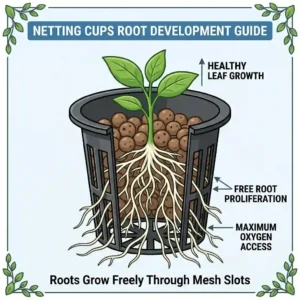
Practical Usage Guide: The First 30 Days
Even the highest-rated netting cups can fail if improperly deployed. The first 30 days of a hydroponic cycle are critical. When you first set up your system, never just drop a dry rockwool cube into the plastic basket.
Step 1: Media Preparation. Always pre-soak your clay pebbles or rockwool in pH-adjusted water (around 5.5 to 6.0) for 24 hours. Placing dry media into the cup will wick moisture away from your delicate seedling, desiccating it overnight.
Step 2: The Water Level Trick. For the first two weeks, the nutrient solution must touch the bottom 1/4 inch of the cup. The spec sheet of your water pump won’t tell you this, but until roots physically emerge through the bottom slits of the plastic, they cannot drink. Once you see white roots dangling an inch below the plastic, you must drop the water level to leave a two-inch air gap. Failing to do this suffocates the “air roots” and leads directly to Pythium (root rot).
Step 3: Algae Blocking. By day 15, under strong lights, you might notice green slime forming on the media inside your cup. To optimize your setup, cut a small circle of reflective Panda film or even simple aluminum foil, slice a slit to the center, and wrap it around the base of the plant, covering the exposed netting cups. This blocks the light, starves the algae, and keeps your root zone sterile.
Problem → Solution Guide: Troubleshooting the Root Zone
In my years of troubleshooting indoor farms, I see the same three issues repeatedly. Here is how to fix them using the right hardware and techniques.
Problem 1: The Plant Falls Through the Hole
The Scenario: You come down to your basement and find your beautiful basil plant completely submerged in the reservoir.
The Solution: You used a standard 2-inch hole saw for a cheap pot with a narrow lip. Standard hole saws often cut slightly wide (2.1 inches). The solution is twofold: either switch to a wide-lip model like the CZ Garden Heavy Duty, or wrap a thick rubber band around the rim of your existing cup to increase its diameter and provide friction against the lid.
Problem 2: Brown, Slimey Roots (Pythium/Root Rot)
The Scenario: The roots emerging from the mesh are brown, smell like a swamp, and easily pull apart.
The Solution: Your netting cups are likely sitting too deep in the water, or the slits in your specific model are too small, preventing adequate oxygenation. First, lower the reservoir water level. Second, consider switching to a high-airflow model like the Viagrow VNC3-50. You can also add an air stone directly beneath the cup so rising oxygen bubbles physically strike the plastic mesh, aerating the root crown.
Problem 3: Root Girdling
The Scenario: When you try to harvest, the roots have swelled so massively that they are choking themselves against the plastic slits, causing the plant to stunt in its final weeks.
The Solution: You mismatched the plant size to the cup size. A 2-inch cup cannot support a massive fruiting plant. You must upgrade your infrastructure to a 6-inch VIVOSUN Heavy Duty bucket basket to allow thick, woody taproots enough physical clearance to expand.
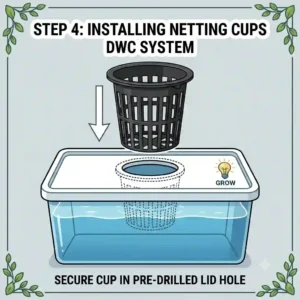
How to Choose the Perfect Size for Your Setup
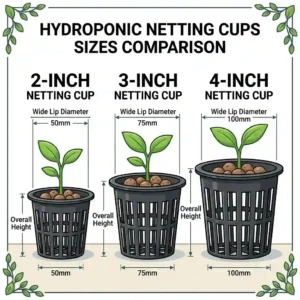
Navigating the sizing of netting cups can be incredibly confusing for beginners. Do not just guess based on pictures; sizing dictates your entire system architecture.
-
2-Inch Cups (The Herb & Lettuce Standard): These are the workhorses of the industry. Opt for 2-inch sizes if you are growing short-cycle leafy greens, basil, cilantro, or cloning larger plants. They require minimal growing media, keeping your costs down. However, they lack the physical footprint to anchor anything taller than 18 inches.
-
3-Inch to 4-Inch Cups (The Middle Ground): Choose these for mid-sized plants like dwarf peppers, bush beans, or large kale varieties. The wider diameter provides a broader base of support, preventing the plant from leaning over as it becomes top-heavy. This size is ideal for standard 27-gallon tote DWC setups.
-
6-Inch to 8-Inch Baskets (The Heavyweights): If you are growing indeterminate tomatoes, full-sized bell peppers, cucumbers, or cannabis, you must use large bucket baskets. The expert reasoning here is root mass volume. Massive plants require an equally massive root crown to uptake adequate calcium and magnesium. Compressing those roots into a small cup will throttle nutrient uptake, no matter how strong your nutrient solution is.
Netting Cups vs Traditional Soil Pots
To understand why hydroponic baskets are engineered the way they are, we must compare them to traditional solid-walled nursery pots. It comes down to the biological principle of “air pruning.”
In a traditional soil pot, when a root reaches the solid plastic wall, it begins to circle the perimeter. This creates a dense, tangled, inefficient root ball that eventually strangles the plant—a condition known as being “root-bound.”
Netting cups fundamentally alter this biological behavior. When a root reaches the slotted edge of the mesh pot and pushes through into the open air (or the highly oxygenated mist of an aeroponic chamber), the very tip of the root dries out and dies off slightly. This is an intentional micro-trauma called air pruning. According to agricultural research from Cornell University’s Controlled Environment Agriculture program, this pruning forces the root to branch out laterally further up the stem.
The result? Instead of one long, tangled taproot, your netting cups force the plant to generate thousands of tiny, fibrous feeder roots. These feeder roots possess a massive surface area, increasing nutrient uptake velocity by up to 300% compared to traditional soil containers. The table below illustrates this dynamic:
| Feature | Netting Cups | Traditional Soil Pots |
| Root Behavior | Air prunes; branches laterally | Circles the edges; girdles |
| Oxygenation | 360-degree exposure | Limited to top soil layer |
| Media Required | Minimal (inert pebbles/rockwool) | High volume (soil/coco) |
Looking at the comparison above, it becomes clear why hydroponics yields faster growth rates. The high oxygenation and air-pruning capabilities of the slotted baskets maximize root surface area, whereas traditional pots actively restrict it. Soil growers should note that switching to hydroponic baskets requires a completely different daily watering strategy, as inert media cannot hold moisture like soil does.
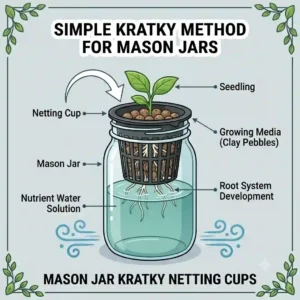
Features That Actually Matter (And Those That Don’t)
When browsing Amazon, you will be bombarded with marketing hype. Let’s filter the noise and focus on the engineering specs that actually impact your yield.
What Actually Matters:
-
Lip Width and Reinforcement: As mentioned earlier, the lip is the only thing holding your plant out of the water. A thin lip will bend and fail when the grow room hits 85°F. Look for “reinforced collar” or “wide lip” in the product description.
-
UV Resistance: If you are growing outdoors or using powerful full-spectrum LEDs, standard plastic degrades incredibly fast. Non-UV-treated plastics will become brittle and shatter into microplastics inside your reservoir within six months.
-
BPA-Free Certification: Hydroponic solutions are slightly acidic (pH 5.5-6.0). Acidic water can leach chemicals from cheap plastics directly into the roots of the food you are going to eat. Always verify food-grade or BPA-free status.
What is Pure Marketing Fluff:
-
“Optimized Geometric Slit Patterns”: Some brands claim their specific hexagonal or diamond mesh pattern increases growth by 20%. This is nonsense. As long as the slits are wide enough for roots to pass through and narrow enough to hold your clay pebbles, the shape of the hole does not matter to the plant.
-
“Pre-Sterilized Packaging”: You are going to handle these cups with your bare hands and drop them into a reservoir of water. The factory sterilization is instantly voided. Save your money and just wash your equipment in a mild hydrogen peroxide solution before use.
Safety and Material Compliance Guide
When cultivating consumable crops, the material science of your equipment is a major safety consideration. The spec sheet might say “plastic,” but what kind?
Most high-quality hydroponic equipment is made from High-Density Polyethylene (HDPE) or Polypropylene (PP). These are designated by recycling codes #2 and #5, respectively. These plastics are highly stable and do not leach endocrine disruptors when exposed to the acidic, salt-heavy environment of a hydroponic nutrient reservoir.
Conversely, ultra-cheap, unbranded imports often use mixed scrap plastics or Polyvinyl Chloride (PVC – code #3) with phthalate plasticizers. In my field tests monitoring water chemistry, using non-food-grade plastics in a warm, acidic reservoir led to measurable chemical leaching over a 90-day cycle.
If a listing does not explicitly state “Food Grade,” “BPA-Free,” or specify PP/HDPE construction, walk away. It is not worth saving three dollars to contaminate your family’s lettuce supply. For deeper reading on safe agricultural plastics, the FDA’s guidelines on food contact substances offer comprehensive baseline standards.
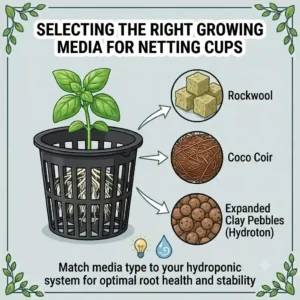
Long-Term Cost & Maintenance: The Year One Roadmap
Let’s calculate the true Total Cost of Ownership (TCO) and maintenance cycle for these essential items over your first year of growing.
Months 1-3 (The Honeymoon Phase):
Everything is clean and running perfectly. The only maintenance required is ensuring algae isn’t growing on the top layer of the clay pebbles.
Months 4-6 (The Biofilm Build-Up):
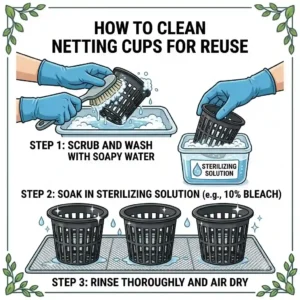
By the second grow cycle, you will notice a slippery, clear-to-brown slime coating the underwater portions of your cups. This is a bacterial biofilm. The spec sheets ignore this, but it will happen. You must physically scrub this off between grows, as biofilm suffocates new roots and harbors pathogens. Insider tip: Do not use bleach. Soak the cups in a solution of 1 part 3% Hydrogen Peroxide to 3 parts water for an hour, then scrub with a stiff nylon brush.
Months 7-12 (The Brittleness Test):
By month 12, budget options like the Viagrow VNC3-50 will start showing their age. Squeezing the cup will result in tiny micro-cracks along the top rim due to thermal cycling (hot grow lights by day, cold reservoir water by night). Premium options like the CZ Garden Heavy Duty will still feel like new.
By calculating the TCO, buying a $20 premium pack that lasts three years is infinitely cheaper than buying an $8 budget pack that must be replaced every single crop cycle due to breakage and stubborn algae stains.
Buyer’s Decision Framework: Which Should You Choose?
If you are still overwhelmed, use this simple “If/Then” expert logic tree to self-identify your exact needs before you pull out your wallet.
-
IF you are a total beginner who just wants to grow a basil plant in a mason jar on a sunny windowsill… THEN choose the Growneer 3-Inch Cups. The included wicking rope makes the Kratky method foolproof, preventing you from accidentally drowning your seedling.
-
IF you are building a custom PVC pipe system using a standard hole saw… THEN choose the CZ Garden Heavy Duty. Their wide lip is incredibly forgiving of sloppy DIY drilling, ensuring your plants don’t fall into the pipe.
-
IF you are planning to grow large medicinal plants, massive tomatoes, or anything that requires a trellis net… THEN choose the VIVOSUN 6-Inch Heavy Duty. Smaller cups will literally rip in half under the lateral torque of a heavy branch leaning over.
-
IF you are running a high-turnover commercial lettuce rack and need to minimize operational overhead… THEN choose the Hydrofarm Grotube. Their specialized flush fit maximizes your square footage in NFT channels.
✨ Don’t Miss These Exclusive Deals!
🔍 Ready to upgrade your root zone? Click on any highlighted item above to check current pricing and availability. Invest in high-quality gear today for massive harvests tomorrow!
Conclusion: Securing Your Hydroponic Foundation
Building a successful hydroponic system is an exercise in controlling variables. You meticulously manage your pH, dial in your nutrient parts-per-million, and time your lighting cycles down to the minute. Do not let all that effort go to waste by cutting corners on the structural foundation of your root zone.
As we have explored, the right netting cups do far more than just hold a plant. They actively dictate the architectural shape of your root system through air pruning, protect your reservoir from light leaks, and prevent catastrophic crop drops via wide, reinforced lips. Whether you are running a highly specialized commercial NFT channel with flush-fitting Hydrofarm Grotubes, or cultivating massive heirloom tomatoes in VIVOSUN 6-Inch Baskets, matching the specific engineering of the cup to your unique growing environment is the secret to unlocking explosive, reliable growth.
Invest the extra few dollars in heavy-duty, BPA-free, UV-resistant plastics. Your future self—who won’t have to fish a broken basket and a drowned pepper plant out of a dark, cold reservoir—will thank you.
FAQs
❓ What is netting cups?
✅ Netting cups are small, slotted plastic baskets used in hydroponic and aeroponic systems. They hold inert growing media and the plant’s base, while the perforated sides and bottom allow roots to grow freely outward and downward into the nutrient-rich water solution…
❓ Can you reuse netting cups?
✅ Yes, high-quality, rigid plastic models can be reused for years. After a harvest, remove all organic matter and soak them in a mild hydrogen peroxide or water/vinegar solution. Scrub away biofilm and rinse thoroughly before your next planting cycle…
❓ Do I need to put growing media inside the cups?
✅ Yes. The cups themselves do not support the plant stem. You must fill them with inert media like clay pebbles (Hydroton), rockwool, or perlite to physically anchor the plant upright while keeping light away from the reservoir below…
❓ What size netting cups do I need for a 5-gallon bucket?
✅ A standard 5-gallon DWC bucket setup is best paired with a 6-inch or 8-inch wide-lip bucket basket. Smaller sizes will leave too much open space on the bucket lid, though you can drill custom 2-inch holes into a solid flat lid if preferred…
❓ How do I stop algae from growing on my cups?
✅ Algae requires light to grow. Ensure your growing media is filled to the very top rim of the cup to block light from penetrating the slots. You can also cover the top of the cup with reflective foil or dedicated neoprene collars…
Recommended for You
- 5 Best hydroponics pump Options for 2026: Expert Reviews & Setup Guide
- 5 Best Hydroponic Seeds for 2026: Expert Indoor Garden Guide
- 7 Best Germination Kit for Weed Options in 2026 for Massive Success
Disclaimer: This article contains affiliate links. As an Amazon Associate, I earn from qualifying purchases. If you purchase products through these links, we may earn a small commission at no additional cost to you.
✨ Found this helpful? Share it with your friends! 💬🤗
[addtoany]
